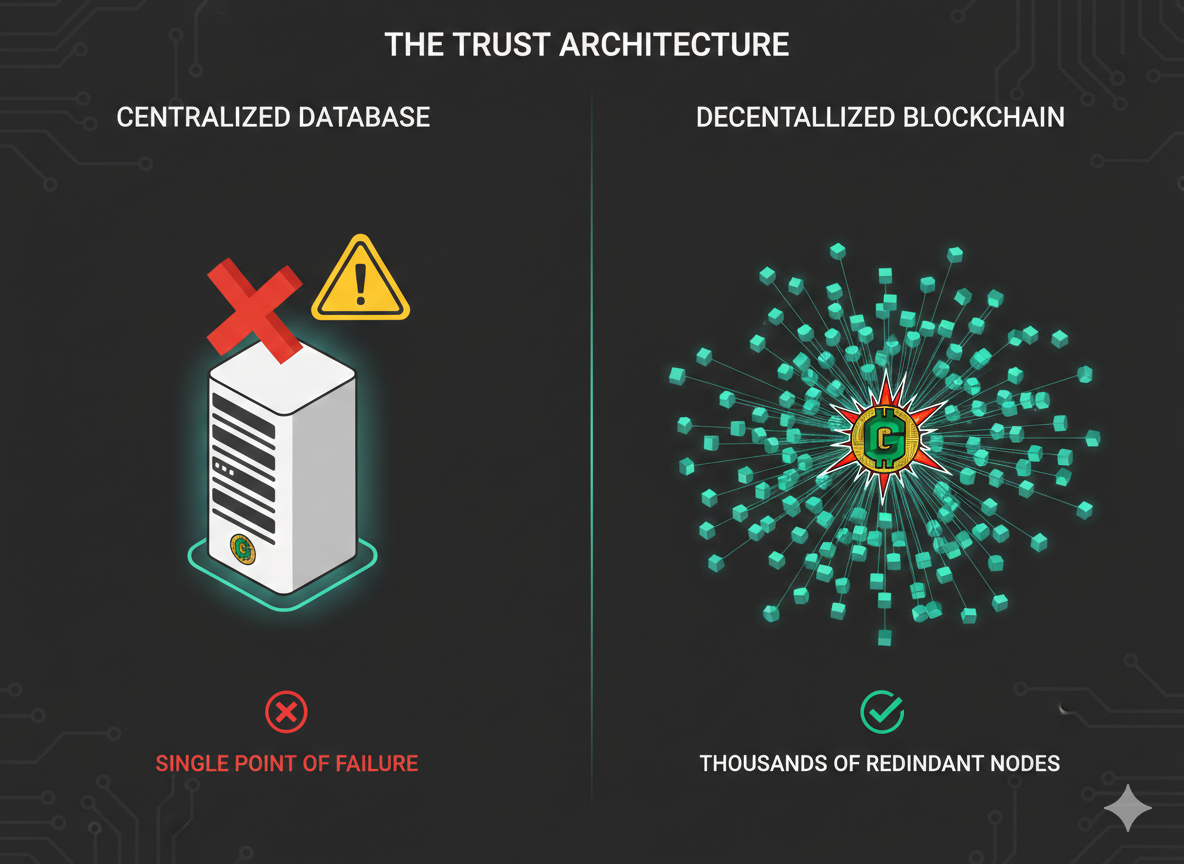

The Token Economy
How GetSmart Creates Value From Recognition
We’ve covered the problem (2 billion unrecognized workers), the solution (peer-to-peer credentials), and the technology (blockchain). Now we address the question everyone asks:
“Why tokens? What gives them value?”
The Core Mechanic
Every time someone earns a badge, two things happen simultaneously:
NFT Badge Minted
Unique credential proving achievement
1,000 Tokens Created
Fungible tokens with real economic value
The badge is your credential—permanent, verifiable, owned forever.
The tokens are your economic stake in the collective mission.
The Supply Model
GetSmart Token has a fixed maximum supply of 1 trillion tokens. This isn’t arbitrary—it’s designed to support billions of workers earning thousands of badges each over decades.
Token Generation Formula
New tokens are ONLY created when badges are claimed.
If 10,000 badges are claimed → 10 million tokens minted
If 100,000 badges are claimed → 100 million tokens minted
If 1 billion badges are claimed → 1 trillion tokens minted
Max supply reached when: 1 billion total badges have been claimed globally.
At current growth rates, we project reaching max supply in:
- Scenario 1 (Conservative): 25-30 years
- Scenario 2 (Moderate): 15-20 years
- Scenario 3 (Aggressive): 8-12 years
Token Distribution Over Time (Projected)
Year 1 (2026):
Year 3 (2028):
Year 5 (2030):
Year 10 (2035):
Year 20 (2045):
How Tokens Get Value
This is the question that trips up most blockchain projects. The answer for GetSmart Token is different from typical cryptocurrencies:
Traditional Crypto Value Creation
- Bitcoin: Scarcity + store of value narrative
- Ethereum: Gas fees for computation
- Most altcoins: Speculation + hype
GetSmart Token Value Creation
- Primary: Collective bargaining power to purchase student debt
- Secondary: Platform utility (creating badges, staking)
- Tertiary: Network effects (more users = more value)
They’re valuable because they’re pooled to buy and erase real debt.
The Dual Token System Explained
GetSmart uses the ERC-1155 multi-token standard, which allows both NFTs and fungible tokens in a single smart contract:
| Feature | Badge NFTs (Token ID 1+) | GetSmart Tokens (Token ID 0) |
|---|---|---|
| Type | Non-fungible (unique) | Fungible (interchangeable) |
| Purpose | Credential/proof of achievement | Economic value/collective bargaining |
| Supply | 1 per badge claimed | 1,000 per badge claimed |
| Transferable? | Yes (you own it) | Yes (tradeable) |
| Can be sold? | Yes (but why? It’s your credential) | Yes (to donors who support mission) |
| Can be staked? | No | Yes (Student Freedom Fund) |
| Metadata | Title, description, proof images, timestamp | None (just a number) |
Where Tokens Go
When 1,000 tokens are minted upon badge claim, they don’t go directly to the earner. Instead:
Token Distribution Flow
- Tokens mint to Server Wallet (nonprofit-controlled treasury)
- 90% transferred to earner’s wallet (900 tokens, worth ~$9)
- 10% retained for operations (100 tokens for platform sustainability)
This 90/10 split ensures:
- Earners get the vast majority of value
- Platform can sustain operations without charging fees
- Nonprofit maintains transparency (all on-chain)
The Deflationary Mechanism
Unlike traditional cryptocurrencies where inflation often dilutes value, GetSmart Token has built-in deflationary pressure:
Burning Events
Unclaimed Badges: If a sponsor creates a badge but no one claims it within 90 days, both the badge NFT and its associated tokens are permanently burned.
Effect: Encourages sponsors to create meaningful, achievable badges. Prevents spam. Creates scarcity over time.
Example:
Sponsor creates 10 badges → 10,000 tokens allocated
Only 7 badges claimed → 7,000 tokens minted to earners
3 badges unclaimed after 90 days → 3,000 tokens burned
Net effect: 3,000 fewer tokens exist than planned
Token Value Calculation
So what’s a GetSmart Token actually worth? This depends on the market, but we can project based on our debt relief model:
Value Floor Calculation:
If $1M in debt is purchased for $10k (1% of face value)
And 10M tokens were sold to raise that $10k
Then each token “created” $0.10 in debt relief value
Implied Token Value: $0.001 – $0.01
But this is the floor, not the ceiling. As the network grows:
- Network effects: More users → More valuable to join → Higher demand for tokens
- Debt leverage: Bulk purchases improve from 1% to 0.5% → Double the impact per token
- Secondary markets: Donors may value tokens higher based on mission alignment
- Staking rewards: Locked tokens reduce circulating supply → Scarcity premium
The Economic Loop
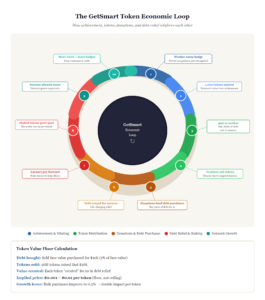
Each loop strengthens the next. This is how we go from helping 20 people in Year 1 to helping 20,000 people by Year 5.
Why Not Just Use Dollars?
This is a fair question. Why create a token at all? Why not just raise money traditionally and buy debt?
What Tokens Enable That Dollars Don’t:
1. Permissionless Participation
Anyone globally can earn tokens. Traditional fundraising requires bank accounts, credit cards, specific currencies. Tokens work for a refugee in Lebanon and a domestic worker in Brazil equally.
2. Transparent Allocation
Every token transaction is on the blockchain. Donors can verify exactly how their contribution is used. No trust required.
3. Programmable Economics
Smart contracts enforce rules automatically. No manual accounting. No possibility of fraud or misappropriation.
4. Network Effects
Tokens appreciate as the network grows. Early supporters benefit from later success, creating alignment between donors and beneficiaries.
5. Global Liquidity
Tokens can be traded 24/7 globally. Dollars require banks, which exclude 1.4 billion people worldwide.
6. Fractional Ownership
You can own 0.000001 tokens. Try owning $0.000001 meaningfully in traditional finance.
Token Security & Custody
All tokens flow through the Server Wallet—a Coinbase-managed multi-party computation (MPC) wallet controlled by the nonprofit board:
- No single point of failure: Multiple signatures required for withdrawals
- Board oversight: Transactions require approval from nonprofit directors
- Transparent operations: All movements visible on blockchain
- Secure infrastructure: Coinbase’s enterprise-grade security
- Sponsored transactions: Users never pay gas fees (we sponsor via Server Wallet)
This architecture ensures tokens are:
- ✓ Secure from hacks
- ✓ Protected from internal fraud
- ✓ Governed democratically
- ✓ Easy to use (no technical knowledge needed)
Earning vs. Buying: Two Ways to Participate
| Method | Who | How | Why |
|---|---|---|---|
| Earn Tokens | Workers, anyone with skills | Claim badges, receive 900 tokens per badge | Zero cost, builds credentials + economic stake |
| Buy Tokens | Donors, mission-aligned supporters | Donate to nonprofit, receive tokens at agreed rate | Support mission, tax-deductible, participate in debt relief |
Both paths support the mission. Both receive tokens. But the purpose differs:
- Earners: Build credentials, potentially get debt relief, can sell for income
- Donors: Support cause, hold to appreciate, stake for maximum impact
The Five-Year Projection
Conservative Growth Model
Year 1 (2026):
10,000 badges claimed → 10M tokens minted
Token value: $0.001
Total market cap: $10,000
Debt purchased: $1M face value for $10k
Year 3 (2028):
1M badges claimed → 1B tokens minted
Token value: $0.005
Total market cap: $5M
Debt purchased: $500M for $5M
Year 5 (2030):
10M badges claimed → 10B tokens minted
Token value: $0.01
Total market cap: $100M
Debt purchased: $10B for $100M
These projections are conservative. If adoption accelerates, we could see 10x growth.
What Happens at Max Supply?
Once 1 trillion tokens have been minted (after ~1 billion badges claimed), no more tokens can be created. At that point:
- Badges continue: Workers still earn credentials (the primary purpose)
- Tokens remain finite: Fixed supply creates scarcity
- Value likely increases: More users competing for fixed supply
- Debt relief continues: Funded through token appreciation + continued donations
- Platform self-sustains: Transaction fees (if implemented) or subscription model for advanced features
The system is designed to outlive its initial token generation phase.
Next Week: The Debt Relief Mechanism
We’ve explained how tokens are created and how they gain value. But we haven’t yet answered the big question:
How exactly do we use these tokens to erase $1.7 trillion in student debt?
Next week, we’ll reveal the collective bargaining model that makes this possible—and why buying debt for pennies on the dollar isn’t just legal, it’s happening right now.
Next Week: The Student Debt Solution
How we buy $100 in debt for $1 and erase it forever. The mechanics explained.
For donors: Tax-deductible donations accepted. Digital Financial Aid Corporation is a 501(c)(3) nonprofit. Learn about SAFT agreements for large contributions ($10k+).